
PMFME Scheme 2026: Complete Guide to Government Subsidy for Food Processing Businesses in India
India’s food processing sector is one of the fastest-growing industries, creating thousands of employment opportunities while reducing post-harvest losses. To strengthen this sector, the Government of India launched the Pradhan Mantri Formalisation of Micro Food Processing Enterprises (PMFME) Scheme, an ambitious initiative by the Ministry of Food Processing Industries (MoFPI).
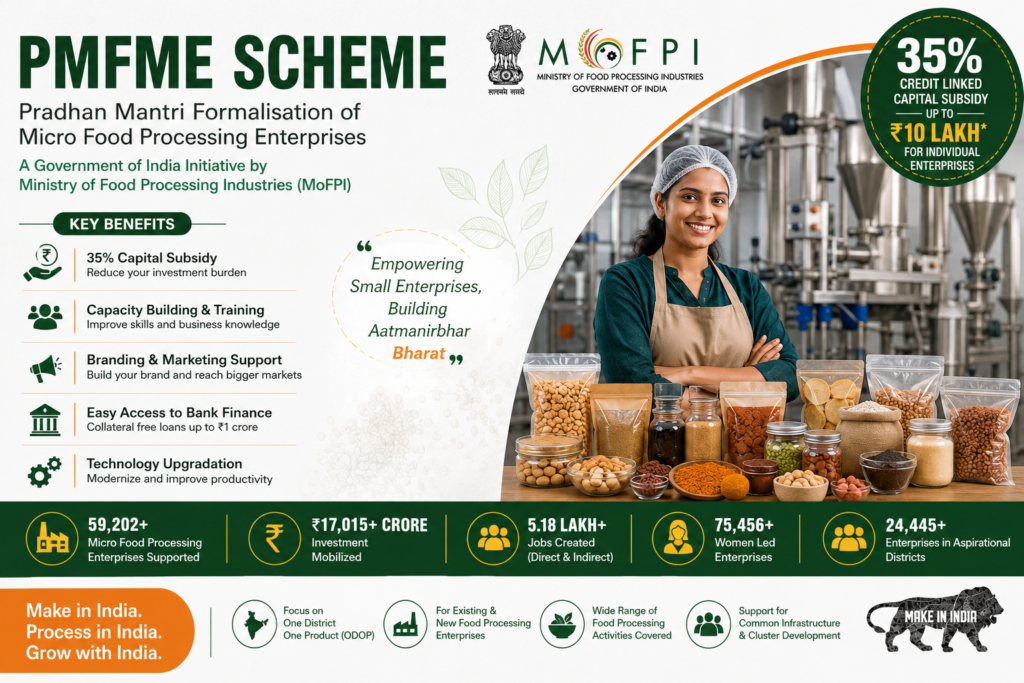
If you are planning to start or expand a food processing business—whether it involves spices, flour, edible oils, bakery products, millet processing, fruit pulp, pickles, dairy, or snacks—this scheme can significantly reduce your investment burden through financial assistance, technical support, branding, and training. The scheme provides 35% credit-linked capital subsidy, subject to prescribed limits, along with capacity building and market support.
In this comprehensive guide, Ahmed Exports explains everything you need to know about the PMFME Scheme, including eligibility, subsidy, application process, documents, benefits, and how it is transforming rural entrepreneurship across India.
What is the PMFME Scheme?
The PM Formalisation of Micro Food Processing Enterprises (PMFME) Scheme is a Centrally Sponsored Scheme launched by the Ministry of Food Processing Industries (MoFPI) to support existing and new micro food processing enterprises through financial assistance, technology upgradation, branding, training, and market access.
The scheme follows the One District One Product (ODOP) approach, encouraging entrepreneurs to focus on products with strong local demand and regional identity, thereby strengthening value chains and improving competitiveness.
Objectives of PMFME Scheme
The primary objectives are:
- Formalize unorganized food processing businesses
- Improve quality and food safety standards
- Increase farmers’ income through value addition
- Generate rural employment
- Promote local products under ODOP
- Encourage women entrepreneurs and Self Help Groups (SHGs)
- Support branding and marketing
- Increase exports of Indian food products
Key Features of PMFME Scheme
1. Credit Linked Capital Subsidy
Eligible entrepreneurs receive 35% capital subsidy on eligible project costs.
- Maximum subsidy for individual enterprises: ₹10 lakh
- Common infrastructure projects: subsidy up to ₹3 crore, subject to scheme norms.
2. One District One Product (ODOP)
Every district identifies a flagship food product such as:
- Rice
- Mustard Oil
- Spices
- Bamboo products
- Fruits
- Honey
- Millets
- Fish products
This helps entrepreneurs receive focused support.
3. Capacity Building
Beneficiaries receive:
- Entrepreneurship training
- Food safety guidance
- Packaging support
- Business planning
- Financial management
- Marketing assistance
4. Branding & Marketing Support
The scheme supports:
- Brand development
- Attractive packaging
- Barcoding
- FSSAI compliance
- Product labeling
- National marketing
5. Common Infrastructure
Support includes:
- Cold Storage
- Warehouse
- Primary Processing Centre
- Collection Centre
- Packaging Unit
- Incubation Centre
Who Can Apply?
Eligible applicants include:
- Individual entrepreneurs
- Existing food processing units
- Proprietorship firms
- Partnership firms
- Farmer Producer Organizations (FPOs)
- Self Help Groups (SHGs)
- Cooperatives
- Producer Companies
- NGOs involved in food processing
Eligible Food Processing Businesses
PMFME covers a wide range of food processing activities, including:
- Flour Mill
- Spice Grinding
- Rice Milling
- Oil Extraction
- Pickle Manufacturing
- Bakery Products
- Namkeen
- Papad
- Millet Processing
- Fruit Processing
- Vegetable Processing
- Jam & Jelly
- Honey Processing
- Dairy Products
- Meat Processing
- Fish Processing
- Ready-to-Eat Foods
- Snack Manufacturing
PMFME Subsidy Structure
| Category | Subsidy |
|---|---|
| Individual Unit | 35% of eligible project cost (up to ₹10 lakh) |
| SHG Seed Capital | As per scheme guidelines |
| Common Infrastructure | 35% (up to ₹3 crore) |
| Branding & Marketing | Assistance available under scheme guidelines |
Documents Required
Applicants generally require:
- Aadhaar Card
- PAN Card
- Passport Photograph
- Bank Account Details
- Project Report (DPR)
- Quotations for Machinery
- Address Proof
- Business Registration (if applicable)
- FSSAI Registration (if applicable)
- GST Registration (if applicable)
- Caste Certificate (where applicable)
- Income Certificate (if required by State)
How to Apply for PMFME Scheme
Step 1
Prepare a Detailed Project Report (DPR).
Step 2
Identify your district’s One District One Product (ODOP).
Step 3
Collect quotations for machinery and equipment.
Step 4
Apply through the official PMFME portal.
Step 5
Your application is reviewed by the District Resource Person (DRP), bank, and State Nodal Agency.
Step 6
After approval, the bank sanctions the loan.
Step 7
Install machinery and begin production.
Role of Ahmed Exports
Ahmed Exports supports entrepreneurs by supplying reliable food processing machinery for a wide range of applications, including:
- Flour Mills
- Oil Expellers
- Pulverizers
- Spice Grinding Machines
- Ribbon Mixers
- Pulverizing Systems
- Fruit & Vegetable Processing Equipment
- Packaging Machines
- Seed Processing Equipment
- Food Processing Plants
Selecting suitable equipment and maintaining proper documentation can make the financing process smoother and help ensure the machinery aligns with the project’s technical requirements.
Impact of PMFME Scheme on India
The PMFME Scheme has significantly strengthened India’s micro food processing ecosystem.
As of 31 December 2025:
- 59,202 micro food processing enterprises have been formalized.
- More than ₹17,015 crore of investment has been mobilized.
- Approximately 5.18 lakh direct and indirect jobs have been generated.
- Loans have been sanctioned for 75,456 women-led enterprises, 1,427 SHGs, 270 FPOs, and 24,445 enterprises in aspirational districts.
These achievements demonstrate the scheme’s role in promoting entrepreneurship, formalization, and rural economic development.
Why PMFME Matters
The scheme helps entrepreneurs:
- Start businesses with lower capital burden
- Access bank finance more easily
- Improve product quality
- Increase profits through value addition
- Generate employment
- Build recognized brands
- Expand into national and export markets
Tips for Faster Approval
- Prepare a professional DPR.
- Choose quality machinery from reputable suppliers.
- Maintain a good credit profile.
- Ensure quotations are complete and accurate.
- Obtain required registrations such as FSSAI and GST where applicable.
- Respond promptly to queries from banks and authorities.
Conclusion
The PMFME Scheme is one of India’s most significant initiatives for strengthening micro food processing enterprises. Through capital subsidy, training, branding support, and easier access to finance, it empowers entrepreneurs to establish sustainable businesses while contributing to employment generation and agricultural value addition.
Whether you plan to launch a spice unit, flour mill, oil extraction plant, millet processing unit, or any other food processing venture, PMFME can substantially reduce your initial investment and help accelerate growth.
At Ahmed Exports, we are committed to helping entrepreneurs choose reliable food processing machinery and understand the technical aspects of setting up successful processing units.
FAQ (SEO Optimized)
What is the subsidy under PMFME Scheme?
Eligible enterprises can receive a 35% credit-linked capital subsidy, subject to the limits specified under the scheme.
Who can apply for PMFME?
Individuals, SHGs, FPOs, cooperatives, producer companies, NGOs, and eligible food processing enterprises can apply.
Is PMFME available across India?
Yes. The scheme is implemented throughout India in partnership with State and Union Territory governments.
Is a bank loan mandatory?
Yes. PMFME is primarily a credit-linked subsidy scheme, meaning the subsidy is linked to eligible bank-financed projects.
Which businesses are eligible?
Most food processing businesses, including flour mills, spice processing, oil extraction, dairy, bakery, fruit and vegetable processing, millet products, and packaged food manufacturing, are eligible if they meet the scheme conditions.